
Dry skin. Chin breakouts. Darker pigmentation. Skincare that used to work suddenly stinging. For many women, the first noticeable signs of perimenopause don’t show up in a lab test—they show up on their face.
Hormonal shifts during perimenopause and menopause directly impact skin hydration, oil production, collagen integrity, and barrier function. The most frustrating part? Your skin can become drier, more sensitive, and more prone to breakouts all at the exact same time.
As pharmacists who focus on skin health, we see this transition every day. The single biggest mistake is continuing to treat the skin you used to have, or aggressively layering active products. Before adding another serum, it helps to understand what is actually changing beneath the surface.
In This Article:
- Key Takeaways (TL;DR)
- Why Does Skin Change During Perimenopause and Menopause?
- Why Is My Skin Suddenly So Dry or Reactive?
- Why Am I Getting Chin Acne During Perimenopause?
- Why Does Pigmentation Look Darker During Menopause?
- Why Does Skin Lose Firmness So Quickly?
- What Is the Best Skincare Framework for Menopause?
- 5 Common Menopausal Skincare Mistakes to Avoid
- Practical Daily Adjustments for Sensitive Skin
- Author Credentials & Review
Key Takeaways (TL;DR)
- No “Menopause Face”: Skin doesn’t follow one pattern. You might experience dryness, breakouts, pigmentation, or all three at once.
- Stop Aggressive Exfoliation: Flaky or dull skin is often a damaged skin barrier, not a need for stronger acids.
- Incidental UV Matters: In sunny climates like Queensland, everyday exposure (driving, walking the dog) drives menopausal pigmentation and collagen loss just as much as beach days.
- Simplify Before Intensifying: Skincare shouldn’t hurt to work. If products sting, pare back to a basic cleanser, moisturiser, and sun protection first.
- Medical Assessment First: Persistent acne, rapid hair shedding, or changing pigmented spots require proper clinical assessment, not just cosmetics.
Why Does Skin Change During Perimenopause and Menopause?
Significant shifts in hormone levels—particularly declining oestrogen—alter the skin’s structural foundation. Oestrogen plays a crucial role in supporting skin hydration, natural oil balance, collagen synthesis, and barrier resilience.
However, these changes do not manifest identically for everyone:
- One person may experience severe dryness and tightness.
- Another may develop stubborn jawline breakouts.
- Someone else may notice hyperpigmentation or sudden reactivity.
Because there is no universal “menopause skin type,” buying off-the-shelf “50+ skincare” rarely delivers results.
Why Is My Skin Suddenly So Dry or Reactive?
Hormonal fluctuations impair the skin barrier’s ability to retain moisture and keep irritants out.
Pharmacist Clinical Insight: Don’t automatically exfoliate the flakes. When skin feels rough, the instinct is to reach for scrubs or strong hydroxy acids. But if your barrier is already compromised, aggressive exfoliation accelerates irritation. If your skin stings, simplify your routine before trying to intensify it.
Why Am I Getting Chin Acne During Perimenopause?
Adult hormonal breakouts typically target the lower third of the face—the chin and jawline. This occurs as changing hormone ratios alter sebum (oil) composition and cell turnover.
Unlike teenage acne, menopausal acne occurs on skin that is often simultaneously dry or barrier-compromised. Using harsh, drying spot treatments designed for teenage skin strips the surrounding area, leaving your face inflamed, flaky, and still breaking out.
Why Does Pigmentation Look Darker During Menopause?
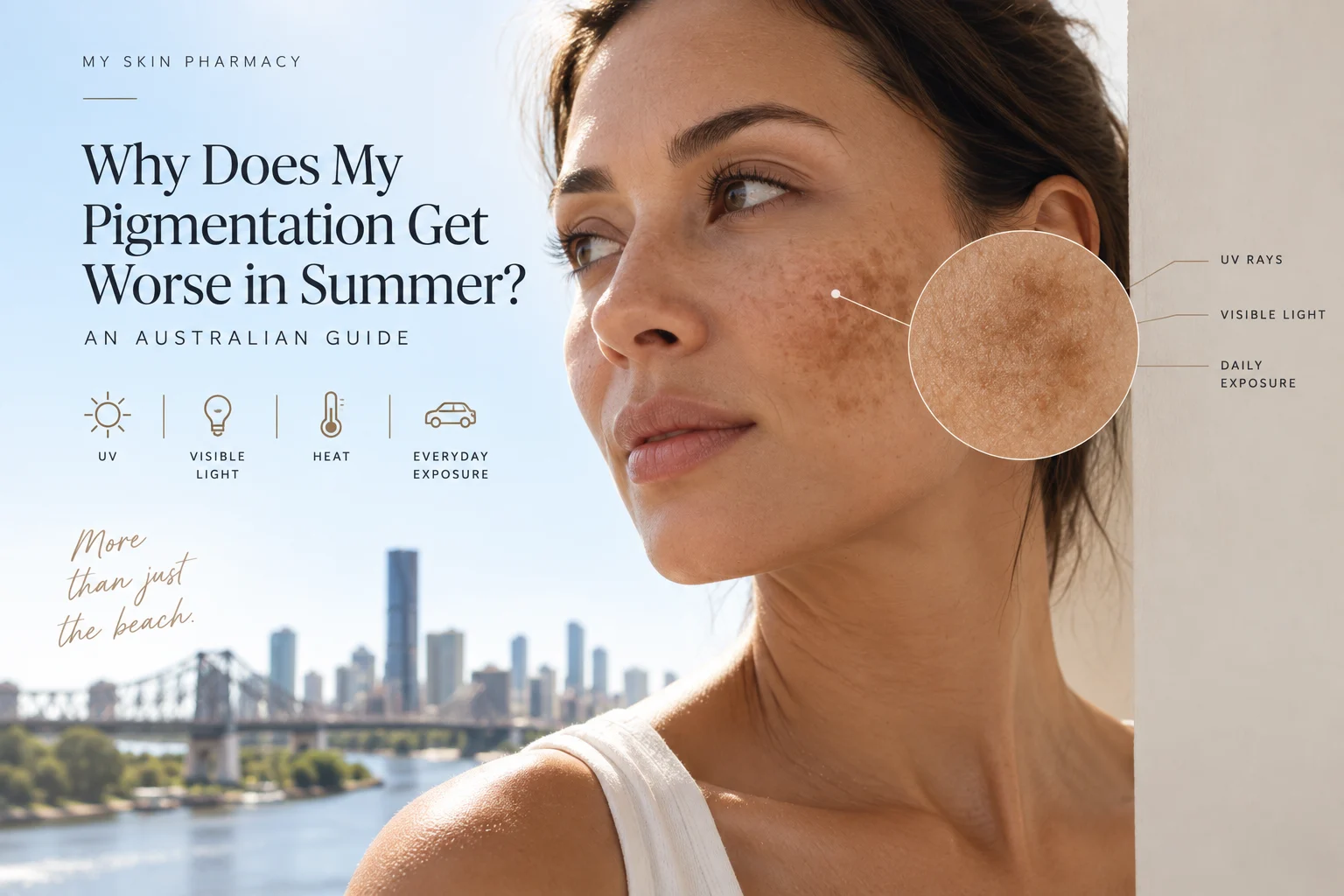
Hormonal shifts render pigment-producing cells (melanocytes) more reactive to external triggers. While internal hormones set the stage, external factors like UV exposure and localized skin inflammation trigger the actual darkening.
In high-UV regions (such as Brisbane and regional Queensland), incidental exposure accumulates rapidly during daily tasks like driving, gardening, or walking near windows.
Note: Not every brown spot is benign hyperpigmentation. Any new, evolving, or changing pigmented lesion must be formally evaluated by a health professional.
Why Does Skin Lose Firmness So Quickly?
Collagen provides structural support to the dermis. As collagen production naturally decelerates with age and hormonal transitions, the skin may gradually feel thinner, less resilient, and show more pronounced fine lines.
No topical cosmetic cream can completely reverse natural structural ageing. A pragmatic goal is supporting your existing skin architecture: protect it from environmental oxidative stress, maintain robust barrier function, and select ingredients targeted to your specific tolerance.
What Is the Best Skincare Framework for Menopause?
There is no single “best” routine, but a functional framework focuses on protection by day and barrier restoration by night.
Morning Routine
- Gentle Wash: Rinse with water or a non-foaming, barrier-safe cleanser. (If skin is very dry, avoid harsh morning cleansing).
- Targeted Support: Apply a simple, hydration-focused or antioxidant product matched to your main concern.
- Moisturise: Hydrate according to how your skin feels today, not the age group on the bottle.
- Broad-Spectrum Sun Protection: Non-negotiable daily defense against UV-driven pigmentation and collagen loss.
Evening Routine
- Remove the Day: Thoroughly clear away SPF, makeup, and pollutants with a non-stripping cleanser.
- Purposeful Actives: Limit active ingredients (like retinoids or mild exfoliants) to items that target your specific goals without overlap.
- Barrier Repair: Apply a rich, supportive night cream or lipid-replenishing moisturiser.
5 Common Menopausal Skincare Mistakes to Avoid
| Mistake | Why It Backfires | Better Approach |
|---|---|---|
| Treating 50-year-old skin like a teenager’s | Drying acne cleansers destroy mature skin barriers. | Support the barrier while treating localized breakouts gently. |
| Exfoliating away texture | Roughness is often inflammation, not built-up dead skin. | Pause acids and focus on barrier repair for 2–4 weeks. |
| Changing 5 products at once | Impossible to identify triggers or effective ingredients. | Introduce or swap one product at a time over 3 weeks. |
| Duplicating active ingredients | Combining active cleansers, toners, and serums over-exfoliates. | Audit labels to ensure you aren’t doubling up on acids. |
| Assuming everything is “just hormones” | May delay diagnosis of underlying dermatological issues. | Get persistent rashes, changing spots, or hair loss clinically checked. |
Practical Daily Adjustments for Sensitive Skin
- Lower the Water Temperature: Very hot showers strip essential epidermal lipids, worsening dryness.
- Ditch the “Squeaky Clean” Feel: Tightness after washing means your cleanser has stripped your skin’s natural protective oils.
- Protect During Daily Life: Apply sunscreen every morning regardless of whether you are spending the day outdoors.
- Give Routines Time: Constant product-switching confuses the skin barrier. Allow 6–8 weeks to evaluate actual changes.
- Monitor Hair & Scalp: Perimenopausal changes also affect scalp density. Significant shedding or widening parts should be clinically assessed.
Have questions about your changing skin?
My Skin Pharmacy is a Brisbane pharmacy with a particular focus on skin.
If your skin has changed during perimenopause or menopause and you’re unsure whether your current skincare still suits you, our pharmacists can help you review your routine, understand how your products fit together and identify when further assessment may be appropriate.
→ Book a Pharmacist Skincare Consultation
Healthcare practitioners
We work with healthcare practitioners and clinics across Australia. Practitioners who would like to discuss pharmacy services or an individual patient’s requirements can email us at info@myskinpharmacy.com. au or to go our practitioner page.
This article provides general educational information only and is not intended to diagnose a condition or recommend a particular medicine or treatment. Individual health concerns should be discussed with an appropriately qualified healthcare professional.
Author Credentials & Review
- Author: Lane (Clinical Pharmacist & Skin Health Specialist)
- Medical Focus: Integrative Skin Health, Hormonal Skin Physiology & Barrier Repair
- Last Reviewed: September 2026
References
- Thornton MJ. Estrogens and aging skin. Dermato-Endocrinology. 2013;5(2):264–270.
- Calleja-Agius J, Brincat M. The effect of menopause on the skin and other connective tissues. Gynecological Endocrinology. 2012;28(4):273–277.
- Shu YY, Maibach HI. Estrogen and skin. American Journal of Clinical Dermatology. 2011;12(5):297–311.
- Farage MA, Miller KW, Elsner P, Maibach HI. Characteristics of the ageing skin. Advances in Wound Care. 2013;2(1):5–10.
- Australasian Menopause Society. Menopause health information.
- Cancer Council Australia. Sun protection and UV exposure guidance.
What would you like to do next?
Shop our range, get personalised advice, or send us your prescription.