

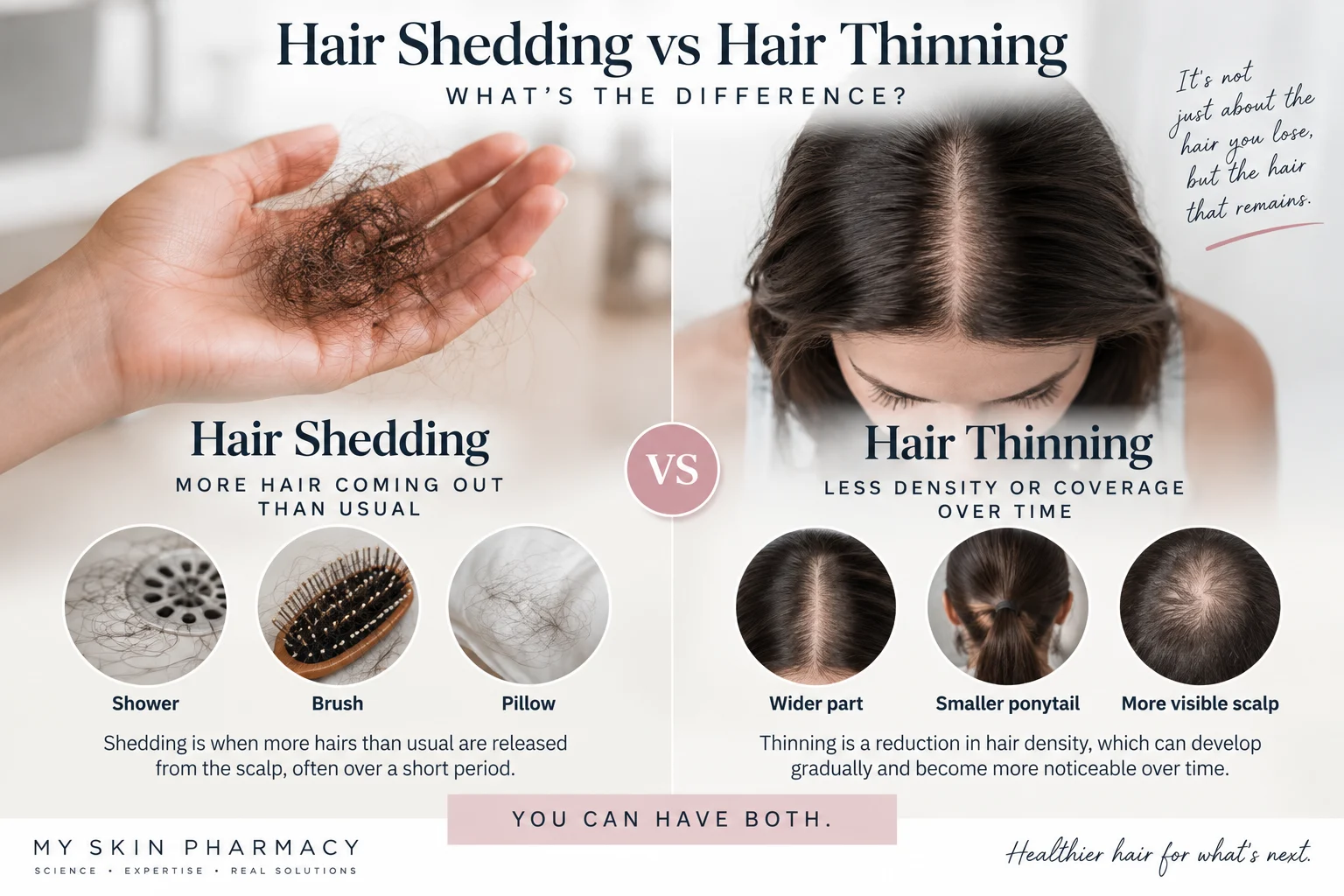
Finding more hair than usual in the shower or on your brush can be alarming. However, hair shedding and hair thinning are distinct processes—and recognising the difference helps you understand what your hair and body might be telling you.
Shedding describes an increased volume of hair being released from the scalp, often over a relatively short timeframe. Thinning describes a decline in overall hair density, which becomes noticeable through a wider part line, a smaller ponytail, or increased scalp visibility. You can also experience both simultaneously.
When reviewing hair changes, the most useful question to ask first is not “How much hair am I losing?” but rather: “What has actually changed, and over what timeframe?”
Table of Contents
- Key Takeaways (TL;DR)
- Am I Shedding Hair or Is My Hair Thinning?
- Why Am I Suddenly Shedding So Much Hair?
- What Does Hair Thinning Look Like?
- Can You Experience Shedding and Thinning at the Same Time?
- Lane’s 60-Second Hair Check
- Contextual Health Factors to Consider
- When to Seek Professional Assessment
- A Pharmacist’s Perspective
Key Takeaways
- Shedding vs. Thinning: Shedding means you are noticing more loose hairs falling out than usual. Thinning refers to a reduction in overall hair density and coverage over time.
- Timing & Triggers: Sudden shedding often occurs weeks or months after a physical, hormonal, or emotional trigger, whereas thinning tends to develop gradually.
- Overlapping Conditions: You can experience shedding and thinning at the same time.
- Tracking Progress: Rather than counting individual strands daily, track visual changes over time using consistent photos.
- When to Seek Help: Rapid loss, patchy loss, or scalp symptoms like redness, scaling, or pain warrant a professional health evaluation.
Am I Shedding Hair or Is My Hair Thinning?
The easiest way to distinguish between the two is to separate loose hair volume from overall scalp coverage.
Why Am I Suddenly Shedding So Much Hair?
Sudden, increased shedding often occurs weeks to months after an underlying trigger. Because of this delay, the root cause may not be immediately obvious when you first notice the hair falling out.
When investigating sudden increased shedding, it is crucial to look back at what was happening in your life three to four months prior. Relevant factors can include:
- Recent systemic illness or high fever
- Significant physical or psychological stress
- Surgical procedures or major bodily trauma
- Rapid weight loss or substantial dietary changes
- Nutritional shifts or deficiencies
- Hormonal fluctuations (such as postpartum changes)
- Starting, stopping, or changing certain medications
While stress is a common contributor, increased shedding should not automatically be labelled as purely stress-related without looking at the broader context of your health.
What Does Hair Thinning Look Like?
Unlike sudden shedding, hair thinning is usually a gradual process. It is characterised by a steady reduction in hair density across specific areas or the entire scalp, rather than dramatic daily hair loss.
Common Signs of Hair Thinning
- A centre or side part line that appears wider than before
- More scalp showing through under overhead lighting
- Ponytails or braids feeling noticeably less substantial
- Reduced coverage around the temples or crown
- Hair appearing flatter or less voluminous in photographs
Because these changes happen slowly, they can be difficult to notice day-to-day until compared with older photos.
Can You Experience Shedding and Thinning at the Same Time?
Yes. Increased hair shedding can occur alongside an existing pattern of gradual hair thinning.
This distinction is particularly important because a sudden increase in shedding often brings attention to hair changes that may have been developing slowly in the background. A person might notice a sudden cluster of hair loss in the shower, but historical photos might reveal that their part line or temple density had already been changing for months.
Identifying both what changed suddenly and what has been changing gradually provides a clearer picture for clinical assessment.
Lane’s 60-Second Hair Check
Rather than trying to count every strand of hair on your bathroom floor, use this baseline visual tracking method:
- Take 3 Baseline Photos:
- The Part Line: Direct photo from above your head showing your main part.
- The Temples/Hairline: Clear photos of both side temples at eye level.
- The Crown: A photo taken from behind/above focusing on the top rear of the scalp.
- Create a Dedicated Album: Save these images in a folder titled “Hair Check.”
- Maintain Consistency: Re-photograph every 4 to 8 weeks using the same lighting, hairstyle, and camera angle.
Tracking long-term visual trends is far more reliable than assessing day-to-day wash variations.
Contextual Health Factors to Consider
Hair growth cycles are closely tied to general physiological health. When evaluating hair changes, consider whether any of the following have occurred recently:
- Physical Stressors: Illnesses, surgeries, or major physical events in preceding months.
- Nutritional Changes: Shifts in diet, restricted intake, or altered nutrient absorption.
- Medication Updates: Recent adjustments to prescription medications (always consult your doctor or pharmacist before making any changes).
- Life Stage & Hormonal Transitions: Postpartum recovery or perimenopause/menopause.
- Scalp Health: Symptoms such as persistent itching, scaling, redness, tenderness, or defined patchy loss.
When to Seek Professional Assessment
While minor variations in daily shedding are normal, health professional evaluation is recommended if you experience:
- Rapid or persistently high levels of hair shedding
- Distinct, well-defined round or oval patches of hair loss
- Noticeable, ongoing widening of your part line or scalp exposure
- Scalp symptoms such as pain, redness, burning, scaling, or pustules
- Hair loss extending to eyebrows, eyelashes, or body hair
- Any suspected scarring on the scalp
- Hair changes accompanied by uncharacteristic physical symptoms
A Pharmacist’s Perspective
When people seek advice about hair changes, the first question is frequently: “What product should I use?”
From a clinical perspective, management starts with understanding the nature of the change. Identifying whether you are experiencing shedding, thinning, or a combination of both—alongside the timeline and medical context—helps determine whether simple monitoring, lifestyle adjustments, or further medical evaluation is the appropriate next step.
Written and reviewed by: Lane Khin, Pharmacist
Publisher: My Skin Pharmacy | Brisbane, Australia
Last Reviewed: October 2026
Disclaimer: General health education only. This information does not replace individual medical advice, diagnosis, or treatment.
References
- Malkud S. Telogen Effluvium: A Review. Journal of Clinical and Diagnostic Research. 2015;9(9):WE01–WE03.
- Mysore V, Parthasaradhi A, Kharkar RD, et al. Expert consensus on the management of telogen effluvium in India. International Journal of Trichology. 2019.
- Therapeutic Goods Administration (TGA). Advertising requirements for disease education activities. Australian Department of Health and Aged Care.
What would you like to do next?
Shop our range, get personalised advice, or send us your prescription.