

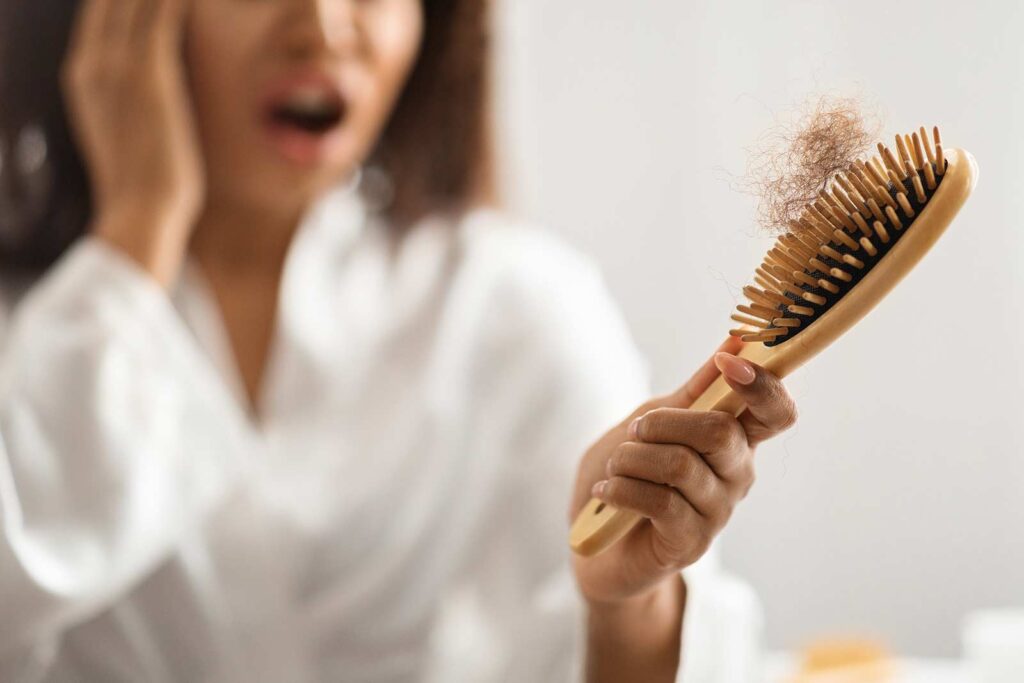
Not all hair loss is the same.
Some people notice a gradually widening part. Others see their hairline changing, increased shedding in the shower, a thinner ponytail or a sudden patch where hair has disappeared.
And while it is tempting to immediately ask “What should I use for hair loss?”, there is a more important question to answer first:
Why is the hair loss happening?
Genetics, hormones, nutritional status, illness, stress, medications, scalp health and hairstyling practices can all influence hair growth.
Understanding the pattern and possible cause is an important first step.
What Are the Most Common Causes of Hair Loss?
Hair loss is an umbrella term rather than a single diagnosis.
Common causes and contributing factors include:
1. Androgenetic Alopecia
Androgenetic alopecia is a common form of progressive hair loss influenced by genetics and hormones.
It can affect both men and women, although the pattern may look different.
Men may notice recession around the temples or thinning through the crown.
Women may notice a widening part, reduced density through the top of the scalp or a ponytail that gradually feels thinner.
2. Telogen Effluvium
Have you suddenly started finding significantly more hair in your brush, shower or on your clothes?
This may be a pattern of excessive shedding known as telogen effluvium.
It can occur after physiological or emotional stressors such as illness, surgery, significant dietary changes, major stress or hormonal changes.
The important distinction is that increased shedding and progressive patterned thinning are not necessarily the same thing.
3. Hormonal Changes
Hair growth is influenced by hormones.
Some people notice changes in hair density during periods of hormonal transition, including after pregnancy and around menopause.
Thyroid disorders and other medical or hormonal conditions may also be associated with changes in hair growth.
If hair loss is unexplained or accompanied by other symptoms, appropriate medical assessment may be warranted.
4. Nutritional Factors
Adequate nutrition is important for normal hair growth.
Iron status, overall protein and energy intake and other nutritional factors may be relevant in some people experiencing hair loss.
However, taking supplements without identifying a deficiency is not necessarily the answer.
If a nutritional deficiency is suspected, discuss appropriate assessment with your healthcare professional.
5. Alopecia Areata
Alopecia areata is an autoimmune condition that can cause distinctive areas of hair loss.
It may present quite differently from gradual patterned thinning or generalised shedding and should be appropriately assessed.
6. Scalp Conditions
The scalp itself matters.
Inflammation, infection and certain dermatological conditions affecting the scalp can sometimes contribute to changes in hair growth or shedding.
Persistent itching, scaling, redness, pain or visible scalp changes alongside hair loss are worth discussing with a healthcare professional.
7. Hairstyling and Traction
Repeated tension from tightly pulled hairstyles can contribute to traction alopecia.
Hair breakage from excessive heat, chemical processing or mechanical damage can also make the hair appear thinner, although breakage is not necessarily the same as hair loss occurring from the follicle.
Hair Shedding or Hair Thinning: What’s the Difference?
This is one of the most useful distinctions to make.
Hair shedding usually describes an increase in the number of hairs being lost.
Hair thinning describes a reduction in hair density or progressive change in the thickness and distribution of the hair.
Someone can experience one or both.
For example, sudden shedding following an illness can look very different from a hairline that has gradually changed over several years.
That difference can provide an important clue about what may be happening.
Does Hair Loss Look Different in Women and Men?
It can.
Patterned hair loss in men often becomes noticeable around the temples, frontal hairline or crown.
In women, changes may be more subtle. A widening central part, reduced density through the top of the scalp or a gradually thinner ponytail may be the first sign.
This is why comparing your hair with old photographs can sometimes be more informative than looking at it every morning.
Gradual changes can be difficult to notice when you see yourself every day.
What About Hair Loss Around Menopause?
Some women notice changes in their hair during the years around menopause.
The concern may not necessarily be dramatic bald patches. Instead, it may be:
- reduced overall density
- a wider part
- finer-feeling hair
- increased shedding
- changes around the frontal hairline.
Hormonal changes are only one possible contributor, however.
Age, genetics, nutritional factors, thyroid function, stress, medications and other health factors may also need consideration.
A personalised assessment therefore matters more than assuming every midlife hair change is simply “menopause hair loss”.
Why Hair Loss Needs a Personalised Approach
Consider three people who all say:
“My hair is falling out.”
One has experienced sudden shedding several months after a significant illness.
Another has noticed their part gradually widening over five years.
A third has developed an isolated patch of hair loss.
Their complaint sounds similar.
Their underlying problem may be completely different.
That is why hair-loss management should start with understanding the individual pattern, timeline and possible contributing factors, rather than immediately choosing a product.
What Should Be Considered When Assessing Hair Loss?
A useful hair-loss history may include:
Pattern: Is the hair loss diffuse, patterned or occurring in patches?
Timeline: Did it happen suddenly or gradually over several years?
Shedding: Has the amount of hair being shed noticeably increased?
Family history: Is there a family history of patterned hair loss?
Hormonal stage: Have there been recent pregnancy, postpartum or menopausal changes?
Health history: Has there been illness, surgery, significant stress or unexplained weight change?
Nutrition: Have there been major dietary changes or concerns about nutritional status?
Medications: Did the change coincide with starting or changing medication?
Scalp health: Is there itching, redness, scaling or discomfort?
Hair practices: Are tight hairstyles, extensions, bleaching, heat or chemical treatments contributing?
Looking at these factors together provides considerably more information than simply asking whether someone “has hair loss”.
Does Ethnicity Affect Hair and Hair Loss?
Hair characteristics vary considerably between individuals and populations.
Hair fibre shape, curl pattern, density and common grooming practices can differ across ethnic backgrounds. These differences can influence how breakage, scalp visibility and some forms of hair loss present.
Certain hairstyling practices involving repeated tension may also be particularly relevant when assessing traction-related hair loss.
However, ethnicity should never be used as a shortcut to diagnosis.
Your individual hair pattern, scalp, history and symptoms matter more than an ethnic label.
Can Stress Really Cause Hair Shedding?
Yes, significant physiological or emotional stress can be associated with increased hair shedding.
The timing can sometimes be confusing because the shedding may not necessarily occur at exactly the same time as the triggering event.
This is another reason why looking back over the preceding months can be useful when investigating a sudden change in hair.
Can Low Iron Be Associated With Hair Loss?
Iron status may be relevant when investigating hair loss in some individuals, particularly when there are other reasons to suspect iron deficiency.
However, hair loss has many possible causes.
Rather than assuming iron — or any other nutrient — is responsible, appropriate assessment can help determine whether further investigation is warranted.
Can Hair Loss Be Caused by Medication?
Some medications can be associated with changes in hair growth or shedding.
If you notice a significant change after starting or changing medication, do not stop a prescribed medicine without speaking to your healthcare professional.
Instead, discuss the timing and symptoms with your doctor or pharmacist.
What Can I Do to Support Healthy Hair and Scalp?
There is no universal lifestyle routine that prevents every form of hair loss, but some general principles can support hair and scalp health.
Eat a Balanced Diet
Hair growth requires adequate energy and nutrients.
Rather than automatically reaching for a “hair supplement”, consider whether your overall diet provides adequate protein and nutritional variety.
Treat Your Hair Gently
Repeated heat, chemical processing and mechanical tension can contribute to breakage and hair damage.
If your hair is already becoming finer or more fragile, gentler styling practices may be appropriate.
Avoid Persistent Traction
Regularly wearing very tight hairstyles can place repeated tension on the hair and scalp.
Consider varying hairstyles and reducing persistent pulling where possible.
Look After Your Scalp
Persistent redness, itching, scaling or discomfort shouldn’t simply be covered with another cosmetic product.
The scalp is skin too.
If something appears abnormal, consider having it assessed.
Protect an Exposed Scalp From the Sun
As hair density decreases, more scalp may be exposed to ultraviolet radiation.
Appropriate sun-protective measures such as a hat can therefore become increasingly important.
When Should Hair Loss Be Professionally Assessed?
Consider seeking professional advice if you experience:
- sudden or unexplained hair loss
- distinct patches of hair loss
- rapidly progressing thinning
- persistent scalp redness, scaling, pain or inflammation
- hair loss accompanied by other unexplained symptoms
- significant shedding that persists
- changes to the eyebrows or other body hair
- hair loss that is causing significant concern.
Some forms of hair loss require medical diagnosis, so determining what is happening is more important than simply trying another product.
Before You Buy Another Hair-Loss Product, Ask These Questions
If you’re experiencing hair loss, start with:
1. Am I shedding more hair, or is my hair gradually becoming thinner?
2. Is the change diffuse, patterned or patchy?
3. When did I first notice it?
4. What was happening with my health approximately three to six months beforehand?
5. Has anything changed hormonally?
6. Have I changed medications, diet or hairstyling practices?
7. Is my scalp healthy, or am I experiencing itching, redness or scaling?
These questions can help make a professional consultation much more useful.
Frequently Asked Questions About Hair Loss
Why am I suddenly losing so much hair?
Sudden increased shedding can have several possible causes, including physiological stress, illness, hormonal changes and nutritional factors. The timing, pattern and associated symptoms are important when considering possible causes.
Why is my part getting wider?
A gradually widening part can be one presentation of patterned hair loss in women, although other causes are possible. If you are noticing progressive changes in hair density, consider seeking professional assessment.
Is hair shedding after pregnancy normal?
Changes in the normal hair-growth cycle can occur following pregnancy, and some women experience noticeable postpartum shedding. If hair loss is severe, persistent or concerning, seek professional advice.
Does menopause cause hair thinning?
Some women notice changes in hair density around menopause, but hormones are not the only possible factor. Genetics, nutrition, thyroid health, medications and other factors may also need consideration.
Should I take a hair supplement?
Not automatically. Hair loss is not always caused by nutritional deficiency. If a deficiency is suspected, appropriate assessment can help determine whether supplementation is warranted.
Can tight hairstyles cause permanent hair loss?
Repeated traction can contribute to traction alopecia. Persistent or significant changes around areas exposed to tension should be professionally assessed.
How long does hair take to grow?
Hair grows in cycles, which means visible changes in density generally occur gradually rather than overnight. The expected course depends heavily on the underlying cause of the hair loss.
Not Sure What Type of Hair Loss You’re Experiencing? 💬
Hair loss is not one-size-fits-all.
Our pharmacists can discuss your concerns, current medicines and products, and help you understand when further assessment by your GP, dermatologist or another healthcare professional may be appropriate.
📞 Call us on 07 3039 1589
✉️ Email info@myskinpharmacy.com.au
💊 Our Compounding Service
My Skin Pharmacy also provides a personalised compounding service for patients and healthcare practitioners where an individually compounded medicine has been prescribed or otherwise lawfully requested.
For general enquiries about our compounding service, please contact our pharmacy team.
Information provided in this article is general educational information and is not intended to replace individual medical advice, diagnosis or treatment. Hair loss has many possible causes. If you are experiencing sudden, significant, persistent or otherwise concerning hair loss, seek advice from an appropriately qualified healthcare professional.
Written and reviewed by My Skin Pharmacy
Last reviewed: September 2026
What would you like to do next?
Shop our range, get personalised advice, or send us your prescription.