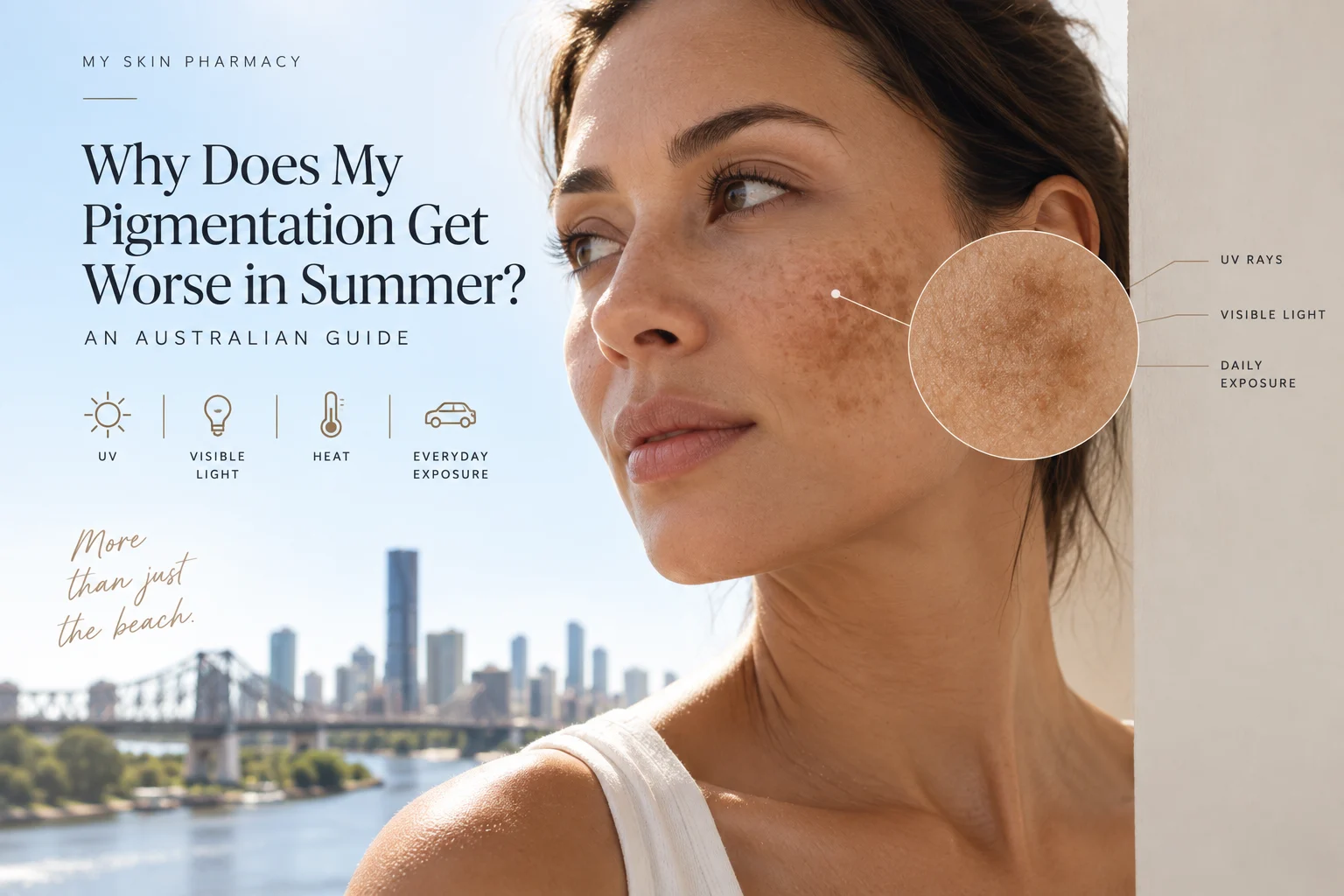


You’ve been diligent with your skincare. Your pigmentation finally looks lighter. Then summer arrives, you spend more time outside — or sometimes seemingly nothing changes at all — and those patches start becoming visible again.
If that sounds familiar, you’re not alone.
Pigmentation is one of the skin concerns we commonly discuss at My Skin Pharmacy, and one of the biggest frustrations is that it can be persistent and recurrent.
The reason? “Pigmentation” isn’t one single condition with one single cause.
Hormones, sun exposure, inflammation, acne, skin irritation, genetics and your individual skin type can all influence pigment production.
Understanding why your pigmentation developed is therefore just as important as trying to improve how it looks.
TL;DR: What should I know about pigmentation?
- Hyperpigmentation describes areas of skin that become darker because of increased pigment.
- Not all pigmentation is the same. Melasma, post-inflammatory hyperpigmentation, freckles and sun-related pigmentation can behave differently.
- UV exposure matters enormously, including the incidental exposure Australians receive during everyday life.
- Hormones can influence pigmentation, which is why some women notice changes during pregnancy, perimenopause or other hormonal stages.
- Inflammation matters too. Acne, irritation and skin injury can leave pigment behind.
- More aggressive skincare isn’t necessarily better. Irritating pigmentation-prone skin can sometimes create another source of inflammation.
- Pigmentation frequently requires a long-term management mindset, rather than expecting it to disappear permanently.
- A new or changing pigmented lesion should be appropriately assessed rather than assumed to be cosmetic pigmentation.
What is hyperpigmentation?
Hyperpigmentation is a broad term describing areas of skin that appear darker than the surrounding skin.
The colour of our skin is influenced by melanin, a pigment produced by specialised cells called melanocytes.
When pigment production or distribution increases in particular areas, those areas may become visibly darker.
Hyperpigmentation may appear as:
- individual dark marks
- freckles or sun spots
- larger patches
- uneven skin tone
- marks remaining after acne or inflammation
- symmetrical patches across areas such as the cheeks or forehead.
The important thing to understand is that these don’t necessarily have the same underlying cause.
That matters when deciding what to do next.
Is hyperpigmentation the same as melasma?
No.
Hyperpigmentation is an umbrella term. Melasma is a particular pigmentation disorder.
Melasma commonly appears as irregular brown or grey-brown patches, often occurring symmetrically on areas such as the cheeks, forehead and upper lip.
Hormonal influences, genetics and exposure to light can contribute to melasma.
Other forms of pigmentation can develop for very different reasons.
For example, a dark mark remaining after an acne lesion is different from pigmentation that has gradually developed after years of sun exposure.
A useful way to think about pigmentation
| What you notice | What may be contributing |
|---|---|
| Symmetrical patches on the cheeks or forehead | Melasma may be one possibility |
| Dark marks after acne | Post-inflammatory pigmentation |
| Pigmentation following irritation or injury | Post-inflammatory pigmentation |
| Freckles becoming darker after summer | Sun exposure |
| Increasing uneven tone over many years | Cumulative sun exposure and ageing may contribute |
| Pigmentation changing around hormonal stages | Hormonal influences may contribute |
This table isn’t intended to diagnose pigmentation.
It illustrates why treating every brown mark as though it were the same problem doesn’t make sense.
Why does pigmentation keep coming back?
This may be the most important question in this article.
Pigmentation can improve and then become more noticeable again because the biological triggers responsible for pigment production haven’t necessarily disappeared.
Think of pigmentation as having triggers, rather than simply being a mark sitting on the surface of your skin.
These triggers can include:
UV exposure → hormones → inflammation → irritation → individual susceptibility
This is particularly relevant with conditions such as melasma, which can be recurrent.
It means successful pigmentation care isn’t simply about making existing pigment look lighter.
It’s also about understanding and managing the factors that may encourage it to return.
Why does pigmentation get darker in summer?
Sunlight is an important stimulus for melanin production.
That’s why freckles often become darker after sun exposure and why many people notice pigmentation becoming more obvious during warmer months.
But there’s an important Australian reality here:
Your skin doesn’t know whether you’re “at the beach” or simply living your life.
For our Brisbane patients, exposure can accumulate while:
- driving
- walking to get coffee
- doing school drop-off
- watching children’s sport
- gardening
- exercising outdoors
- sitting outside at lunch
- walking the dog.
A beautiful sunny Queensland lifestyle means sun protection needs to be part of normal life when pigmentation is a concern — not something reserved for beach holidays.
Pharmacist tip
If pigmentation repeatedly improves during one part of the year and becomes more noticeable during another, look at what has changed in your daily exposure, not just your skincare.
Can hormones cause pigmentation?
Hormones can influence pigmentation, particularly in conditions such as melasma.
This helps explain why pigmentation can become noticeable or change during hormonally dynamic stages of life.
Women may first become particularly aware of pigmentation during or following pregnancy, for example.
Skin can also change during perimenopause and menopause, although hormones are only one part of the pigmentation story.
Genetics, sun exposure and inflammation can all interact.
If you’ve noticed that your pigmentation and skin have changed around perimenopause or menopause, read our guide to How Your Skin Changes During Perimenopause and Menopause.
Why does acne leave dark marks?
This is known as post-inflammatory hyperpigmentation.
When skin becomes inflamed or injured, pigment production can be altered as part of the inflammatory response.
This means the pimple itself may disappear while the mark it leaves behind remains visible much longer.
The same principle can occur following other inflammatory skin problems or irritation.
This is also one reason we strongly discourage repeatedly picking acne lesions.
You’re not only increasing trauma to the skin — you’re potentially creating more inflammation.
And for pigmentation-prone skin, inflammation matters.
Can irritating skincare make pigmentation worse?
It can contribute to the problem in some people.
This is an area where more isn’t necessarily better.
When someone becomes frustrated with pigmentation, there’s a natural tendency to become increasingly aggressive:
“It’s not improving fast enough, so I’ll add something stronger.”
Then another active product is added.
Then another exfoliant.
Then a scrub.
Suddenly the routine intended to improve pigmentation has created redness, sensitivity and inflammation.
If your skin is burning, peeling excessively or persistently irritated, don’t assume that’s proof your skincare is “working harder”.
One of the patterns we see in pharmacy
People often focus entirely on removing pigment and forget about the health of the surrounding skin.
Your pigmentation routine still needs to be something your skin can tolerate.
Why isn’t my pigmentation skincare working?
There are several possibilities.
1. The type of pigmentation hasn’t been properly identified
“Brown mark” isn’t a diagnosis.
Different types of pigmentation can behave differently.
2. You’re still being exposed to the trigger
You may have an excellent skincare routine but inconsistent sun protection.
3. Inflammation is continuing
Persistent acne or irritation may continue creating new pigmentation.
4. You’re changing your routine too frequently
Pigmentation doesn’t usually change overnight.
Constantly swapping products can make it difficult to know what’s helping.
5. You’re expecting permanent removal
Some pigmentation conditions have a tendency to recur.
For these, long-term management and trigger reduction may be a more realistic goal than expecting a permanent one-off fix.
6. Your skincare may be too aggressive
If you’re constantly red, flaky and irritated, it may be time to reassess the entire routine rather than simply adding another product.
How long does pigmentation take to improve?
There isn’t one universal timeline.
Pigmentation may have developed over months or years, and its behaviour depends on factors including:
- the type of pigmentation
- how long it has been present
- your skin type
- sun exposure
- inflammation
- hormonal influences
- the depth and nature of the pigment
- consistency with your skincare and sun-protection strategy.
This is why promises of extremely rapid or permanent pigmentation removal should be treated cautiously.
Think in months, not days
Taking a photograph in consistent lighting every few weeks can sometimes be more useful than examining your face in the mirror every morning.
Day-to-day changes are difficult to judge objectively.
What should a pigmentation skincare routine focus on?
Rather than giving every person the same list of products, we prefer to think about the jobs a good routine needs to perform.
1. Protect
If pigmentation is being continually stimulated by environmental exposure, this needs attention.
Sun protection is fundamental.
2. Maintain the skin barrier
A pigmentation routine shouldn’t leave your face permanently irritated.
3. Address inflammation
If acne or another inflammatory skin problem is contributing to pigmentation, simply focusing on the dark marks may miss part of the problem.
4. Be consistent
A simple routine used consistently is often more useful than an elaborate routine changed every fortnight.
5. Make it individual
Someone with melasma, sensitive skin and dryness may need a different approach from someone dealing with post-acne pigmentation and oily skin.
Pigmentation isn’t one-size-fits-all.
Pigmentation mistakes we commonly see
❌ Treating every dark spot as the same thing
Different causes require different thinking.
❌ Only wearing sunscreen when it’s sunny
UV exposure isn’t restricted to hot summer days.
❌ Picking acne
The inflammation and trauma can contribute to the marks you’re trying to prevent.
❌ Exfoliating more whenever progress slows
More irritation isn’t necessarily more progress.
❌ Starting five products simultaneously
If your skin reacts, you’ll have no idea which one caused it.
❌ Expecting years of pigmentation to disappear in two weeks
Pigmentation management usually requires patience.
❌ Ignoring the skin barrier
Pigmentation-prone skin still needs to be healthy skin.
When should pigmentation be checked by a doctor?
This is important.
Not every pigmented lesion is cosmetic hyperpigmentation.
Seek appropriate medical assessment for a spot or lesion that is:
- new or changing
- changing in shape, size or colour
- irregular
- bleeding
- persistently itchy
- noticeably different from your other spots
- concerning to you for any reason.
Australia has high levels of skin cancer, so don’t self-diagnose a changing lesion as “just pigmentation”.
When in doubt, get it checked.
Frequently asked questions about hyperpigmentation
Can hyperpigmentation go away on its own?
Some pigmentation following inflammation may gradually fade, but this varies considerably depending on its cause, depth, skin type and ongoing triggers.
What’s the difference between pigmentation and hyperpigmentation?
Pigmentation simply refers to colouring in the skin. Hyperpigmentation describes areas where pigmentation has increased, making the skin appear darker than the surrounding area.
Why does my pigmentation come back after it improves?
Triggers such as UV exposure, hormones and inflammation can continue to stimulate pigment production. Some pigmentation conditions also naturally have a tendency to recur.
Does sunscreen help pigmentation?
Sun protection is an important part of caring for pigmentation-prone skin because UV exposure can stimulate pigment production and make existing pigmentation more noticeable.
Can acne cause pigmentation?
Yes. Inflammation following acne can leave darker marks known as post-inflammatory hyperpigmentation.
Can hormones make pigmentation worse?
Hormonal influences can contribute to certain pigmentation conditions, particularly melasma. Hormones are usually only one part of the picture.
Why is my pigmentation worse on my cheeks and upper lip?
Certain pigmentation conditions, including melasma, commonly affect these areas. However, pigmentation should be appropriately assessed rather than diagnosed based solely on its location.
Should I exfoliate pigmentation every day?
Not automatically. Excessive exfoliation can cause irritation, and inflammation can be particularly unhelpful in pigmentation-prone skin.
Why does pigmentation look worse after a holiday?
Increased exposure to sunlight may stimulate pigment production, making existing pigmentation more noticeable.
Is pigmentation permanent?
It depends on the type and cause. Some pigmentation can fade considerably, while other conditions may have a recurrent or long-term nature.
The most important thing to understand about pigmentation
Pigmentation isn’t simply about finding the strongest product.
It is about asking:
What type of pigmentation might this be?
What is triggering it?
Is inflammation contributing?
How much incidental sun exposure am I getting?
Is my current routine helping my skin — or irritating it?
And does this pigmentation actually need to be medically assessed?
Once you start asking those questions, pigmentation becomes much less about chasing the next trending product and much more about developing a considered, long-term approach to your skin.
Not sure where to start with your pigmentation?
If you’re using multiple skincare products and aren’t sure how they fit together, My Skin Pharmacy pharmacists can help you review your current skincare routine and identify potential duplication, irritation or areas that may need further professional assessment.
→ Book a Pharmacist Skincare Consultation
Already under the care of a doctor or dermatologist?
Continue to follow the advice and treatment plan provided by your healthcare practitioner. If you have questions about your skincare routine or pharmacy services, you’re welcome to contact us on info@myskinpharmacy.com.au
For doctors, dermatologists and healthcare practitioners
My Skin Pharmacy works with healthcare practitioners and clinics across Australia.
For practitioner enquiries or to discuss the pharmacy needs of an individual patient, please contact our pharmacist team directly.
→ Healthcare Practitioner Enquiries
This article provides general educational information only. It is not intended to diagnose hyperpigmentation, recommend a particular medicine or replace individual medical advice. New, changing or concerning pigmented lesions should be assessed by an appropriately qualified healthcare professional.
References
- Passeron T, Picardo M. Melasma, a photoaging disorder. Pigment Cell & Melanoma Research. 2018;31(4):461–465.
- Ogbechie-Godec OA, Elbuluk N. Melasma: an up-to-date comprehensive review. Dermatology and Therapy. 2017;7(3):305–318.
- Davis EC, Callender VD. Postinflammatory hyperpigmentation: a review of the epidemiology, clinical features and treatment options in skin of colour. Journal of Clinical and Aesthetic Dermatology. 2010;3(7):20–31.
- Handel AC, Miot LDB, Miot HA. Melasma: a clinical and epidemiological review. Anais Brasileiros de Dermatologia. 2014;89(5):771–782.
- DermNet New Zealand. Melasma and hyperpigmentation.
- Cancer Council Australia. Sun protection and skin cancer information.
What would you like to do next?
Shop our range, get personalised advice, or send us your prescription.