
If you’re 38, 42, or 46 and have found yourself looking in the mirror thinking, “Why does my face suddenly look different?”, it may not simply be your imagination—or just “getting older.”
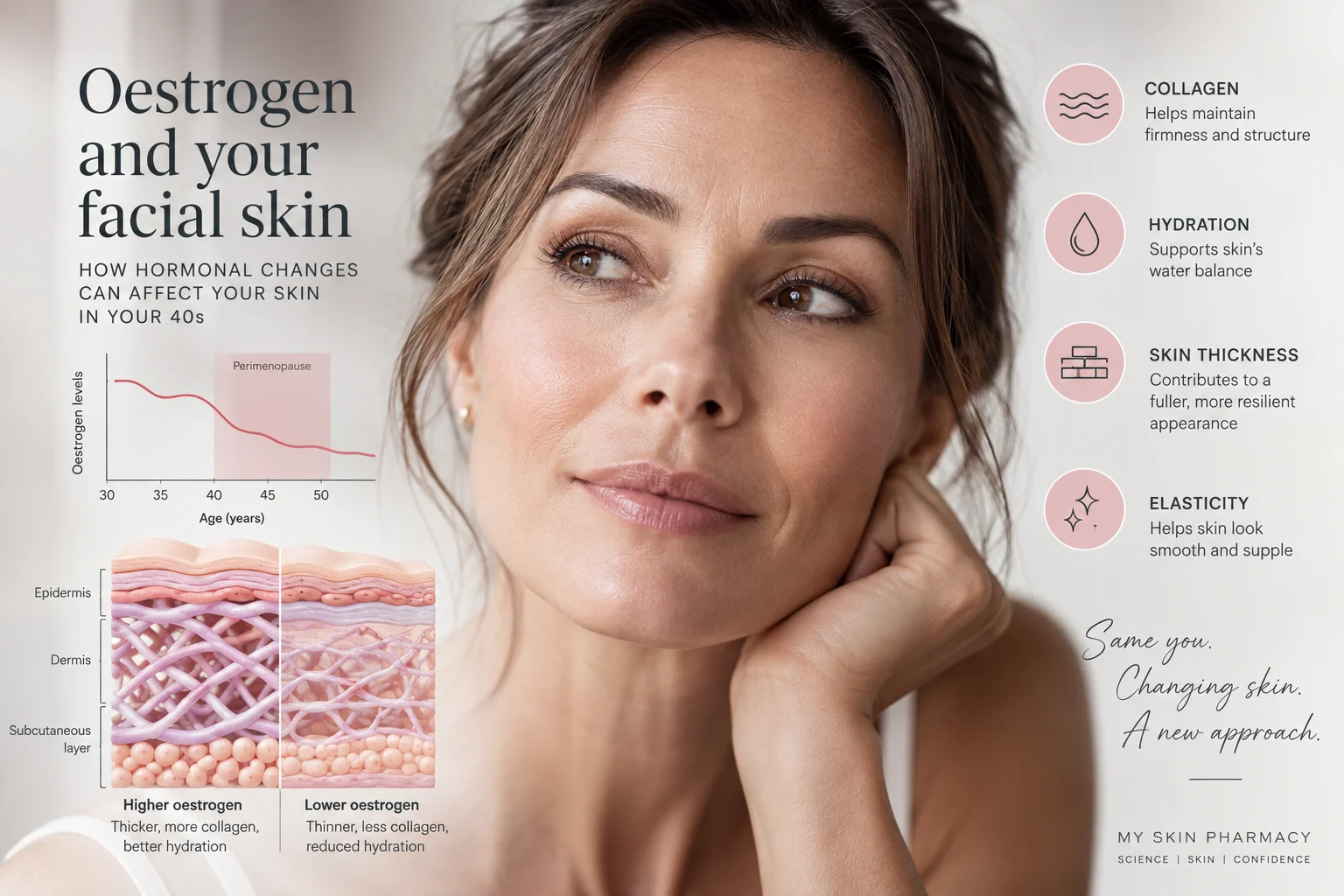
Oestrogen significantly influences collagen density, skin hydration, and overall facial skin physiology. As your hormonal environment begins shifting during perimenopause, your skin can start behaving differently—often while you are still having regular periods and long before you consider yourself menopausal.
It usually isn’t a single dramatic wrinkle that makes you notice. It’s that your makeup doesn’t sit smoothly, your cheeks feel parched by lunchtime, your trusted skincare suddenly stings, or you’re dealing with chin breakouts and fine lines at the exact same time.
In This Article:
- Key Takeaways (TL;DR)
- I’m Not Menopausal—So Why Is My Skin Changing?
- What Does Oestrogen Actually Have to Do With My Face?
- Why Does It Feel Like My Face Changed Overnight?
- Common Skincare Mistakes Women Make in Their 40s
- My Tips When Your Skin Stops Behaving Like Your Skin
- A Pharmacist’s Perspective
- Have Questions About Your Changing Skin in Your 40s?
- Author Credentials & Medical Review
- References
Key Takeaways (TL;DR)
- Hormonal Physiology: Oestrogen plays an active role in maintaining skin collagen, barrier thickness, and moisture retention.
- Early Transition: Perimenopause begins years before menopause itself; facial changes can occur while your menstrual cycle is still completely regular.
- Overlapping Processes: What feels like “sudden ageing” is usually several distinct factors colliding: dehydration, changing texture, increased sensitivity, or adult breakouts.
- Not Everything Is Hormonal: Sun exposure, genetics, dermatological conditions, and normal chronological ageing continue alongside hormonal shifts.
- Simplify First: Trying to resolve changing skin by aggressively layering stronger active skincare often worsens barrier irritation.
I’m Not Menopausal—So Why Is My Skin Changing?
Because menopause isn’t an on/off switch. The hormonal transition begins beforehand during perimenopause.
This is the woman who frequently gets forgotten in conversations about “menopausal skin”:
- She is 41 years old.
- She still has regular, monthly periods.
- She isn’t shopping in the “mature skin” aisle.
Yet, her previously oily skin suddenly has flaky, dry patches. Her chin is breaking out. Pigmentation seems more pronounced, or the active serum she has used happily for years suddenly burns. She doesn’t think “this is perimenopause”—she thinks “what on earth is happening to my skin?”
What Does Oestrogen Actually Have to Do With My Face?
Facial skin is highly hormonally responsive. Oestrogen directly supports dermal collagen production, skin thickness, elasticity, and the skin barrier’s ability to hold onto water.
| What You Notice | What May Be Happening Underneath |
|---|---|
| “My skin suddenly feels dry by noon.” | Hydration levels and natural epidermal water retention are shifting. |
| “My face doesn’t feel as bouncy.” | Dermal collagen and elastic fibers naturally contribute to skin firmness. |
| “My fine lines suddenly look deeper.” | Dehydration accentuates existing textural lines. |
| “My usual skincare products now sting.” | Skin tolerance or skin barrier integrity may be compromised. |
| “My makeup sits terribly on my cheeks.” | Altered cell turnover and reduced hydration impact foundation texture. |
| “I’m breaking out AND getting fine lines.” | Different age-, skin-, and hormone-related processes are overlapping. |
Important Note: Not every change happening to your face in your 40s is oestrogen-driven. UV exposure, stress, acne, rosacea, dermatitis, and natural chronological ageing continue alongside hormonal shifts. Hormones are one piece of the puzzle, not the sole explanation.
Why Does It Feel Like My Face Changed Overnight?
It feels sudden because several subtle processes reach a tipping point at the exact same stage of life.
Gradual age-related collagen decline has been occurring quietly in the background. Decades of cumulative UV exposure begin showing on the surface. Epidermal water retention decreases, and early perimenopausal hormonal fluctuations begin occurring on top of all of that.
Then one morning, your foundation doesn’t sit properly, and suddenly you notice everything at once. This is usually the moment women begin rapidly purchasing new products: an exfoliant for texture, an active for pigmentation, a strong spot treatment for the chin, and an intensive cream for lines. Before long, the bathroom cabinet becomes a laboratory—and the skin barrier often ends up irritated.
Common Skincare Mistakes Women Make in Their 40s
- Treating 42-year-old skin like 25-year-old skin: Your favourite routine from your late 20s doesn’t have to remain your routine forever.
- Assuming stronger actives equal better results: Repeatedly exfoliating textured or dull skin accelerates barrier damage, especially if dryness is the root cause.
- Trying to fix every concern simultaneously: Introducing four new targeted active products in one week makes it impossible to isolate ingredient sensitivities.
- Labelling every texture change as “ageing”: Dehydration, barrier impairment, or redness often mimic structural ageing.
- Assuming everything is hormonal: Being in your 40s doesn’t automatically make every new rash, breakout, or spot a perimenopause symptom.
- Buying products solely because they say “menopause”: There is no single “menopausal skin type.” Your unique skin history still dictates what ingredients your skin tolerates.
My Tips When Your Skin Stops Behaving Like Your Skin
- Be specific about what changed: Instead of saying “my skin has aged,” identify whether the issue is dryness, sensitivity, chin breakouts, or texture.
- Audit your current routine first: Before adding another bottle, review what you are already applying. Sometimes removing an irritating product is the most effective fix.
- Introduce changes thoughtfully: Swap or add one product at a time over 2 to 3 weeks so you can evaluate how your skin responds.
- Prioritize barrier essentials: Gentle cleansing, adequate hydration, and daily broad-spectrum sun protection remain essential foundations.
A Pharmacist’s Perspective
Pharmacist Clinical Insight: Women in their late 30s and 40s rarely walk into our pharmacy saying, “Lane, I think my oestrogen levels are affecting my dermal collagen.” They say, “I’ve always had oily skin—why am I suddenly so dry?”, “My trusted serum suddenly burns,” or “Why am I getting pimples and wrinkles together?” Your skin hasn’t failed you, and it doesn’t need to be attacked with harsh actives. It simply needs a different approach from the one that worked ten years ago. — Lane Khin, Pharmacist
Have Questions About Your Changing Skin in Your 40s?
My Skin Pharmacy is a Brisbane pharmacy with a dedicated focus on skin physiology, hormonal transitions, and barrier care.
If you are in your late 30s or 40s and your skin suddenly doesn’t feel like your skin anymore, our clinical pharmacists can help you review your existing products, audit for hidden irritants, and build a considered routine tailored to your skin today. To learn more about broad hormonal skin changes as you approach menopause, explore our companion guide on Navigating Perimenopause & Menopause Skin Changes.
→ Book a Pharmacist Skincare Consultation
Healthcare practitioners
We work with healthcare practitioners and clinics across Australia. Practitioners who would like to discuss pharmacy services or an individual patient’s requirements can email us at info@myskinpharmacy.com. au or to go our practitioner page.
This article provides general educational information only and is not intended to diagnose a condition or recommend a particular medicine or treatment. Individual health concerns should be discussed with an appropriately qualified healthcare professional.
Author Credentials & Medical Review
- Author: Lane Khin (Clinical Pharmacist & Skin Health Specialist)
- Practice: My Skin Pharmacy | Brisbane, Australia
- Medical Focus: Hormonal Skin Physiology, Dermal Collagen & Barrier Repair
- Last Reviewed: September 2026
References
- Brincat MP. Oestrogens and the skin. Journal of Cosmetic Dermatology. 2004;3(1):41–49.
- Calleja-Agius J, Brincat M. The effect of menopause on the skin and other connective tissues. Gynecological Endocrinology. 2012;28(4):273–277.
- Kamp E, et al. Menopause, skin and common dermatoses. Part 2: skin disorders. Clinical and Experimental Dermatology. 2022.
- Therapeutic Goods Administration (TGA). Advertising requirements for disease education activities. Guidance on distinguishing health education from therapeutic goods advertising.
- Therapeutic Goods Administration (TGA). Complying with restrictions on advertising prescription medicines to the public. June 2026.
What would you like to do next?
Shop our range, get personalised advice, or send us your prescription.